








Jaipur: Rajasthan’s reservoirs have entered August with less than half their storage capacity, a sharp drop from the same time last year, making the next few weeks of the monsoon crucial for farmers, livestock, and rural drinking water supplies.
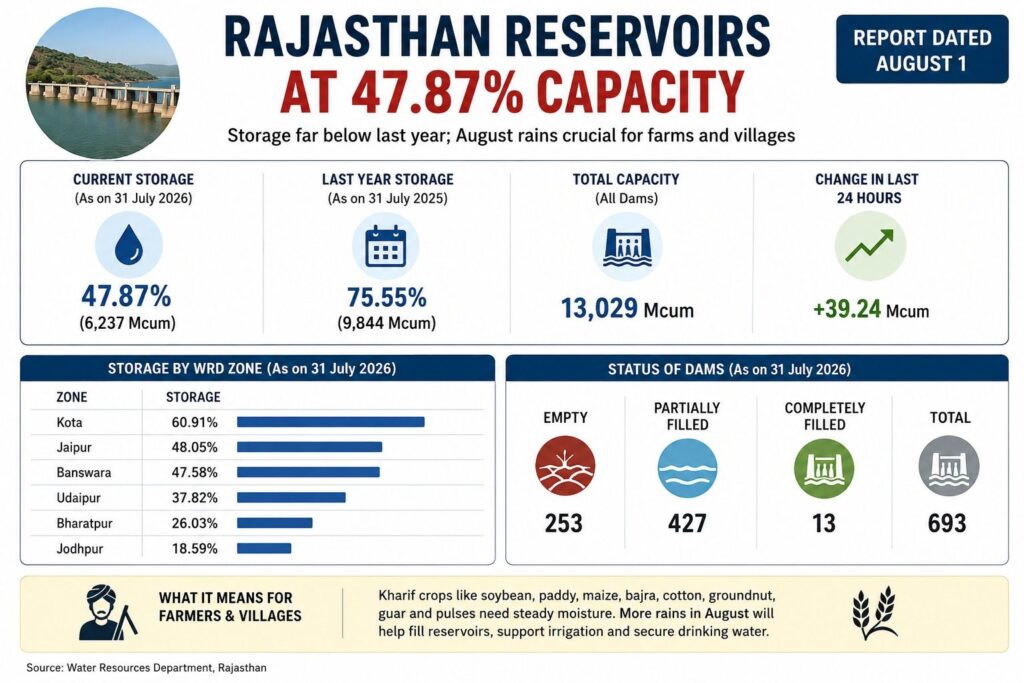
According to the Water Resources Department’s reservoir status report dated August 1, the state’s 693 dams were holding 6,237.46 million cubic metres (Mcum) of water as of July 31—47.87% of their total capacity. On the same day last year, storage stood at 75.55%.
The picture varies across the state. Kota division, the state’s irrigation hub, has the healthiest storage at 60.91%, though that is still well below last year’s 90.34%. Jaipur (48.05%) and Banswara (47.58%) are close to the state average.
The concern is in western and eastern Rajasthan. Reservoirs in Jodhpur division are only 18.59% full, while Bharatpur division stands at 26.03%. Both regions depend heavily on the remaining monsoon weeks to recharge reservoirs before winter.
For farmers, the timing is important. Kharif crops have already been sown across most districts. Soybean, maize and paddy in the Hadoti region, cotton and groundnut in parts of Udaipur and Banswara divisions, and bajra, guar, moong and moth bean across the arid districts of Jodhpur, Barmer, Jaisalmer, Jalore and Nagaur are now entering stages where consistent soil moisture matters more than fresh sowing.
Unlike last year, when reservoirs had already crossed three-fourths of their capacity by the end of July, this year’s storage remains below the halfway mark despite several spells of rain. That leaves little room for a prolonged dry spell in August.
The implications extend beyond agriculture. Reservoirs feed canal systems, supply drinking water to hundreds of villages and towns, recharge wells and provide water for livestock through the dry months. In many parts of western Rajasthan and the Bharatpur region, a good August often determines not only the health of the standing kharif crop but also the availability of water for the rabi season.
The latest report shows that the monsoon has been uneven. Of the state’s 693 dams, 253 are still empty, 427 are partially filled and only 13 have reached full capacity.
The Water Resources Department recorded a modest increase of 39.24 Mcum in storage over the previous 24 hours. For farmers, however, the bigger question is whether the remaining weeks of the monsoon can replenish reservoirs enough to carry the state through the coming irrigation season.